Thursday, 5 May 2016

Class of 4

Today was a very productive day in Biology.

Students became teachers and the teacher became a student. We were all given different topics to learn on our own. And after we learn for a good 20 minutes, we all gather around in one table and teach each what we learnt about. After we teach each other about our lessons, we give them our activities that we came up with. Me and BobbiGrace did Kahoot, Cherub made us a crossword and Lana was to define it and draw a diagram about it.

Cherub: Tropisms and Growth Responses
Tropisms are directional growth responses to external stimuli. It is directional growth because it grows either towards or away the stimuli. Tropisms are identified according to the stimulus involved, e.g. photo- (light), gravi- (gravity), hydro- (water), and are identified as positive or negative. I'll use sunlight as an example. When a plant is growing outside under the sunlight, the plant grows towards the sunlight, this is called POSITIVE PHOTOTROPISM.

BobbiGrace: Investigating Photo-tropism
Photo-tropism is when a plant is growing towards the light. Auxins promote cell elongation and are inactivated by light. But when a stem is exposed to light, auxin becomes unequally disturbed either side of the stem. When a stem is exposed to sunlight on the left, the auxin that is produced in the tip of the shoot, goes down on the right side. This causes the right side to elongate faster than the side that is exposed to sunlight. As this happens the plant bends towards the sun which is called positive PHOTOtropism.

Lana: Investigating Gravitropism
Auxin appears to have a role in the gravitropism response but it has a different effect depending on the presence of other plant growth regulators. 

Tuesday, 3 May 2016

Learning about Migration !


Tuesday 4th of May 2016

Migration is a journey that is often over long distances, often a year or once in a lifetime.
Homing is a short trip home after searching for food or mates.

Animals can navigate when migrating & homing through different ways.
Including: Visual Cues/Landscape, Star Compass, Magnetic and Sun Compass.

Visual Cues/Landscape:
- Landmarks, mountains, buildings, roads, forest, streams etc..
- Birds can use motorway etc. while migrating
- Digger wasp used cones as as visual where 'home' was.
- Change of land (development deforestation) may harm navigation & migration


Star Compass:

Using star for navigation.
Scientists put birds in a conservatory/star dome to see if it were really the stars that the birds were using to navigate. So one night the they put stars up in the conservatory lab. They noticed that the birds were hopping to the left side of their cages. The next time they swapped the stars around and the birds were hopping to the right side of their cages, which gave the scientists the idea that birds really do use stars at night to migrate. Turning out lights at night could help the birds see the stars clearly for them to be able to migrate.

Magnetic:
Image result for MagneticSome animals (eg. pigeons & salmons) have been shown to sense & navigate using the earth's magnetic field. Experiments with magnets on pigeons beaks showed their navigation became confused. So scientist put birds in a cage and had this magnetic technology that you can just switch on and off. Whenever it is switched on the birds would either fly to the left or to the right. When they switched the technology off the birds were shown to just be flying around and not knowing where they're flying to. Scientists also tried test where the magnets that attracted them to the earth's magnetic field were and so they attached some magnets onto their beaks and the birds were shown to be confused about where they're supposed to be flying. And they also found some in their backs.

Sun Compass:
- Sun rises in the east and sets in the west.
- Bees and the waggle dance !
Number of waggle = distance.
Angle of middle = angle to the sun
Bees uses the waggle dance to talk to each other about where their food is. So the number of waggle that the bees do is the distance where the food is away from them. And the angle of the middle is the angle of where the food is to the sun. Just confusing myself right there! haha


So we made posters about all of this and here is mine:


Introducing the NZ God-wit:
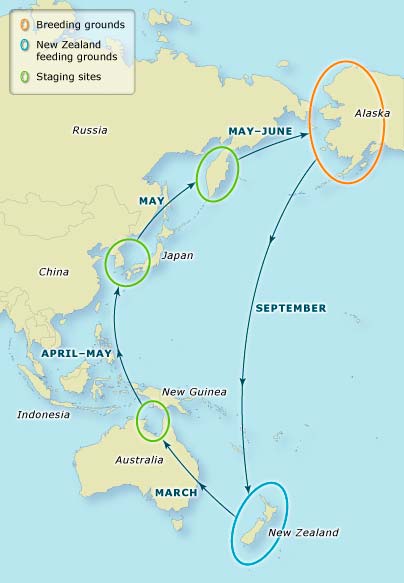
Bar-tailed godwitsโ€™ migration route
As you can see the map on the left shows the distance and stops that the God-wits migrate to and from. Also the map shows how it gets to their destination. The God-wits  are a large group of ling billed, long legged, bar-tailed birds. Their long bills allows them probe deeply in the sand for aquatic worms and mollusks. When god-wits prepare to migrate, they double their weight as the season changes and days get shorter. Because they are not needed for the journey, their stomach, liver and also kidney shrinks. As the journey begins, along the way many birds grow bigger flight muscles. Along the way, many of them stop to rest or to feed. Flying in formation helps them in a way so that they can use the minimum energy along the journey, also by travelling in higher air that is less dense. Some birds are led by experienced birds, and others just migrate on their own for the first time. This is called innate. Innate is a behavior that is not taught, it's in their genes, they all do it the same way and they all do it at the same time. So birds that migrate on its own is an example of innate behavior.
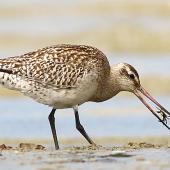
Bar-tailed godwit. Juvenile swallowing mud crab (note patterned plumage on wing, compared to the plainer coverts of adults). Whanganui River estuary, October 2015. Image © Ormond Torr by Ormond Torr


Thank You for reading my blog!
Enjoy the rest of your day
God Bless

Monday, 4 April 2016

Class of 3

Hi All ๐Ÿ˜Š๐Ÿ˜Š

Yesterday there were only three of us. Bobbi, Lana and Me. Also with Miss Wells.

First, we did some learning about PHOTOtropism in the roots. And then she allowed us to work on our assessment and just try finish it up for a grade. Land and Bobbi did their assessment, but I and Miss Wells did our own work on the board. Miss Wells would draw pictures on the board and then I would have to caption it. Here it is:
Just read the caption so you'll know what I learnt that day.


Thank you for reading my blog ๐Ÿ˜Š๐Ÿ˜Š Have a good day/night

Auxin

Hi, All ๐Ÿ˜ƒ๐Ÿ˜ƒ

On the last day of March, we had a special visitor. She just came into our class and sat in the back and just observed how we use our netbooks and how useful it is to our learning.  We were so grateful as a class that she learnt something from our little lessons and I'm pretty sure she had fun. But anyways let me get to what I have to actually talk about.

So on Thursday, our first task was shared to us by our Biology teacher. The class of  8 was divided into two groups, 3 boys and 5 girls. We had to watch a video first and then answer the questions that were shared to us by our Biology teacher. When we finish that task we had to make a presentation out of dough.

Here it is:

Monday, 21 March 2016

Attracting Mates

Pheromones.

Pheromones is a chemical that plants and animals releases to change the behaviour of animals around them.

Here is an example of Pheromones:


Silly Sentences for Innate

My silly sentence:

"My offspring were raised away by every single member in my family so it can be 100 times better."

My Biology class were told to write our own silly sentence to try and remember what Innate means.
Innate means that a behaviour or something wasn't practised or learnt. It's just in their genes. For example some birds, when they are born they know which directions to fly. Like if we take away those birds from its parents the birds will already know which way to fly. So it was born with it.

Innate = Born with it, not practised.

Monday, 14 March 2016

Biology Fun

Thank God we are still alive :)

Biology today was fun. 
We learnt new prefixes, we played games to remember those prefixes.
Here they are:
Chemo - chemicals (food)
Gravi - gravity
Hydro - water
Thermo - temperature
Thigmo - touch
Photo - light

Our teacher gave us activities to do on our own, and then we have to draw our own little animal thingy and name it ourselves. We came up with our own responses for it.

So Fiu Wazowski is a type of creature that has only one eye and it lights up every night. It loves the light.

What is the adaptive for the Fiu Wazowski ?
What is its environmental cue ?
Orientation ?